Monday, September 26, 2016

Airport Check-In

Checking In For Your Flight

Definitions:

Checking in: for a flight is the process whereby a person announces their arrival at the airport. The check-in process at airports enables passengers to confirm they will be on the respective flight, obtain a boarding pass, possibly select their seat (if hasn’t happened already or allowed by airline), and check in luggage onto a plane, if desired.

Boarding Pass: is a document provided by an airline during check-in, giving a passenger permission to board the airplane for a particular flight. As a minimum, it identifies the passenger, the flight number, and the date and scheduled time for departure. Boarding Passes are always required to board a flight. Often times airlines accept paper or electronic boarding passes (on phone or tablet).

Three ways to Check-In

In person at a staffed check-in counter at airport 
Checking-in in-person allows you to check in your baggage, if checking luggage, at the same time as checking in for your flight.

Items needed for check-in counter check-in:


  1. Passport (when traveling internationally)
  2. Paper ticket (less and less common),
  3. or a confirmation number- usually sent via email if ticket is purchased online or through a travel agency,
  4. or printed itinerary with a confirmation number
In person at airport using a self check-in kiosk 

At this time passengers can select a seat (if hasn’t happened already or allowed by airline), enter number of bags to be checked (if desired), and print boarding passes. Passengers will then need to submit luggage to staffed counter or checked luggage stations. Airline staff will need to check your passport either at time of check in or at gate.


Items needed for kiosk check-in:


  1. Confirmation number- (usually sent via email if ticket is purchased online or through a travel agency),
  2. or the credit card used for payment of the ticket,
  3. and or a passport. Passport required when traveling internationally.

Check in online before arriving to airport

Passengers can check in online starting 24 hours (usually) before departure. Passengers will need to submit luggage to staffed counter or checked luggage stations if checking luggage.


Benefits of online check-in:


  1. Avoid potential check-in lines at airport
  2. Print boarding pass at home (can also wait or reprint at self-service kiosk at the airport)
  3. Select seat assignment(s) before others (if applicable)
  4. Choose to get updates of possible changes to departure times leading up to flight.


https://umabroad.umn.edu/students/travel/airport

Wednesday, October 14, 2015

links for teaching

GRammar:

http://www.eslbase.com/grammar/

Thursday, August 14, 2014

A DETAILED LESSON PLAN IN ENGLISH


I.                     OBJECTIVES:
At the end of the lesson the student must be able to:
a.        Identify things for school.
b.      Enumerate examples of things for school
c.       Make simple sentences about the things for school.
II.                  MATERIALS:  flash cards, book
a.        Things for Schools, Colors and shapes [nouns]
b.        Source:  Let’s go 1, page 4-7
III.                PROCEDURE:
Teacher’s Activity
Student’s Activity
A.       Learning Activties
1.        Motivation
How was your weekend?


Why did you say it was great?


That’s good.  What color is your bike?

Do you like your bike very much?

That is really nice. Okay, but are you ready now for our new lesson.

2.       Review
Before we continue, I would like you to tell me what did we study last Friday?


Yes, very good.  You still remember it.

B.       Lesson Proper
Show the flash cards.

File:Scissor.JPG

What is this?

I would like you to please answer in complete sentences.  Please say:  That is a pair of scissors.

Very good.  One more time please.


How about this, what is this?


Okay.  Yes, these are pencils but how many pencils can you see?

Right, there are many pencils so you have to say:  Those are pencils.  Would you please say it.

Good.  Let’s continue.  Look at the next picture, what is this?


Lined paper pad


Great.  How about this?


Yes, it’s a book.

You did very well.  These things are the things that we use in school.  Do you bring these things in school?

Why do you bring it to school?


Yes, we use it to study and do our activities but please say: I bring these things to school because I use them to study my lessons.


Very good!


What other things do you bring to school?


Very good.  Yes, those are just some of the things you bring to school.

C.      Discussion
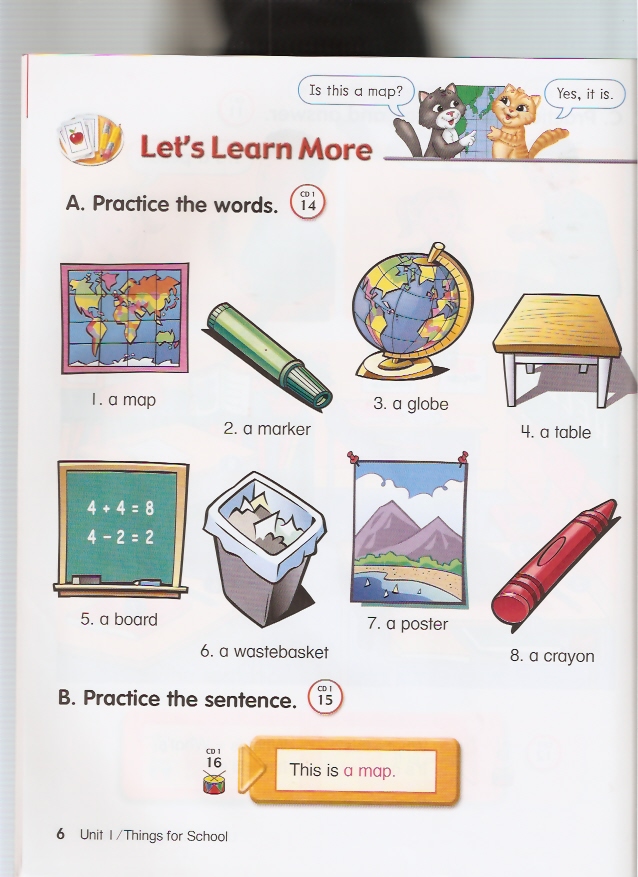
Now, open your book on page 6.(Send the link to the student.  http://www.cubictalk.com/cubicmatrials/child1/LG31/LG31-0006.jpg )

Let’s practice to answer the question:  Is this _____?

First, let’s try to read the question and answer.  Please read after me.

Is this a map?

Yes, it is.

Now, I would like you to make a sentence by completing the sentence: This is _____.  Let us first read the phrases or words on activity A.

1.        A map


-          Is this a map?


2.       A marker


3.       A globe


4.       A table


5.       A board


6.       A wastebasket


7.       A poster


8.       A crayon


That was a perfect one.  Now do you have any questions about our lesson?


D.      GENERALIZATION:

Today we finish discussing about the things we use in school.  Now let’s try to practice the sentences that you have been saying.  One more time instead of saying :

-          Scissors, please say:  That is a pair of scissors.


-          That is a pencil., it’s better to say:  Those are pencils.

Because I use it to study. ; you should say:  :  I bring these things to school because I use them to study my lessons.


Alright.  Those are the sentences that you have been making today. 


           It was great.

     
          My parents bought me a new bike.(the answer varies.


           It’s colored blue. .(the answer varies.

           Yes, I do.

            Yes, I am.


           We studied about how to introduce and greet each other.


             Scissors

         That is a pair of scissors.

            That is a pair of scissors.


         That is a pencil.


            There are many pencils.


            Those are pencils.


           It’s a pad paper.


            It’s a book.


              Yes, I do.

           Because I use it to study.


                   I bring these things to school because I use them to study my lessons.


            I bring my notebook. (the answers would vary.  Some possible answers are: eraser, pencil case, bag, sharpener, ID, etc.)


Is this a map?
          
          Yes, it is.


            This is a map.


            This is a marker.


            This is a globe.


           This a table.


           This a board.


           This is a wastebasket.


          This a poster.


            This is a crayon.


             No, I don’t have./ None.


           That is a pair of scissors.

            Those are pencils.

           I bring these things to school because I use them to study my lessons.

IV.                EVALUATION:
Now let’s have a short quiz.  I would like you to make a sentence using colors to say something about the things you use in school.  Make 5 sentences using the following words:
a.        Notebook
b.      Pencil case
c.       Eraser
d.      Crayon
e.      marker

Example:
  I have a pink bag.
  This is my pink bag.
A.       Notebook  : ____________________________________________________
B.       Pencil case: ____________________________________________________
C.      Eraser          : ____________________________________________________
D.      Crayon        : ____________________________________________________
E.       Marker        : ____________________________________________________


V.                  HOMEWORK:
  Read , study and prepare for activities C and d on page 7 and activities A and B on page 9. 


-           Prepared by ANABELLE KO ALINSO